SASE vs SSE vs ZTNA: Understanding the Key Differences
If you have spent any time evaluating modern security architectures, you have probably run into a wall of overlapping acronyms: SASE, SSE, ZTNA, SWG, CASB, DLP. Each vendor defines them slightly differently, analyst firms keep refining the categories, and the marketing noise makes it genuinely difficult to understand what you actually need to buy, build, or migrate toward.
The confusion is not accidental. These frameworks evolved over several years as Gartner and other analysts tried to keep pace with how organizations were shifting from on-premises data centers to cloud-first, hybrid workforces. The result is a set of nested concepts that are easy to conflate but critical to distinguish when you are making architecture and procurement decisions.
This post breaks down the three most important terms — SASE, SSE, and ZTNA — explains how they relate to each other, and offers a practical decision framework for choosing the right approach for your organization.
What is SASE?
Secure Access Service Edge, or SASE (pronounced “sassy”), is a framework that Gartner introduced in 2019. The core idea is straightforward: converge networking and security into a single, cloud-delivered service.
Traditional enterprise architectures kept networking and security as separate domains. You had your SD-WAN or MPLS for connectivity, and then a stack of security appliances — firewalls, proxies, VPN concentrators — sitting in a data center. Traffic from branch offices and remote users was backhauled through that central location for inspection.
SASE eliminates the backhaul by moving security inspection to the cloud edge, close to the user. It combines two major pillars:
- Networking services: SD-WAN, WAN optimization, quality of service, and routing
- Security services: Secure Web Gateway (SWG), Cloud Access Security Broker (CASB), Zero Trust Network Access (ZTNA), Data Loss Prevention (DLP), DNS-layer security, and firewall-as-a-service
The promise of full SASE is a single vendor or tightly integrated platform that handles both sides. Users connect from any location, traffic is routed intelligently through the nearest cloud point of presence, and security policies are applied consistently regardless of where the user sits or where the application lives.
In practice, achieving single-vendor SASE has been challenging. Most organizations already have SD-WAN investments, security tool sprawl, and contractual obligations that make a rip-and-replace approach impractical. This reality is exactly why Gartner later carved out SSE as a separate category.
What is SSE?
Security Service Edge, or SSE, is the security half of SASE. Gartner formally defined SSE as a category in 2021, recognizing that many organizations wanted to modernize their security stack without necessarily replacing their existing networking infrastructure.
SSE consolidates several cloud-delivered security capabilities into a unified platform:
- Secure Web Gateway (SWG) — Inspects and filters web traffic, blocking malicious sites, enforcing acceptable use policies, and performing SSL/TLS decryption for visibility into encrypted traffic.
- Cloud Access Security Broker (CASB) — Provides visibility and control over SaaS application usage. Inline CASB handles real-time traffic inspection, while API-based CASB scans data at rest in sanctioned cloud apps for policy violations and sensitive data exposure.
- Zero Trust Network Access (ZTNA) — Replaces traditional VPN by providing per-application access based on identity, device posture, and context. More on this below.
- Data Loss Prevention (DLP) — Identifies and prevents sensitive data from leaving the organization through web, cloud, and private application channels.
- DNS Security — Blocks connections to malicious domains at the DNS resolution layer, often serving as the first line of defense before a full proxy inspection.
- Remote Browser Isolation (RBI) — Renders risky web content in an isolated cloud environment, sending only safe pixels to the user’s browser.
The key distinction from SASE is scope. SSE does not include SD-WAN or other networking services. If your organization already has a functioning SD-WAN deployment or is not ready to converge networking and security under one vendor, SSE gives you a path to modernize security independently.
For many organizations, SSE is the practical starting point. You get the zero trust security model, cloud-delivered inspection, and consolidated policy management without rearchitecting your entire network.
What is ZTNA?
Zero Trust Network Access is the most granular of the three concepts. It is not a platform or a framework — it is a specific capability that lives inside SSE (and therefore inside SASE).
Traditional VPNs grant broad network-level access. Once a user connects, they typically have visibility into an entire network segment. This model creates excessive implicit trust and expands the attack surface significantly. If credentials are compromised or a device is infected, the attacker inherits that same broad access.
ZTNA flips this model:
- Per-application access: Users are authorized to reach specific applications, not network segments. An engineer who needs access to a deployment tool does not automatically get access to the HR database.
- Identity and context verification: Every access request is evaluated based on who the user is, what device they are using, where they are connecting from, and whether the device meets security posture requirements. This ties directly to strong authentication controls like MFA.
- Least-privilege enforcement: Access is granted with the minimum permissions necessary and can be revoked dynamically if context changes — for example, if a device falls out of compliance during an active session.
- Application cloaking: Backend applications are never exposed directly to the internet. The ZTNA broker mediates all connections, making applications invisible to unauthorized users and reducing the attack surface for reconnaissance.
ZTNA is often the entry point for organizations beginning a zero trust journey. It delivers immediate, measurable security improvements over VPN while improving the user experience — connections are typically faster because traffic does not need to traverse a central VPN concentrator.
Side-by-Side Comparison
| Dimension | SASE | SSE | ZTNA |
|---|---|---|---|
| Scope | Full convergence of networking + security | Security services only | Per-application access control |
| Networking | Includes SD-WAN, WAN optimization, routing | Not included | Not included |
| Security Services | SWG, CASB, ZTNA, DLP, FWaaS, DNS security | SWG, CASB, ZTNA, DLP, DNS security, RBI | Identity-based, per-app access with posture checks |
| Deployment Model | Cloud-delivered, single vendor or integrated | Cloud-delivered, security-focused | Cloud-delivered or agent-based |
| Primary Use Case | Full network and security transformation | Security modernization without changing networking | Replacing VPN, securing access to private apps |
| Complexity | Highest — requires networking and security convergence | Moderate — security consolidation | Lowest — targeted capability |
| Vendor Examples | Cisco (SD-WAN + Secure Access), Palo Alto Prisma SASE, Fortinet | Cisco Secure Access, Zscaler ZIA/ZPA, Netskope | Cisco Secure Access ZTNA, Zscaler ZPA, Cloudflare Access |
How They Relate: The Nested Architecture
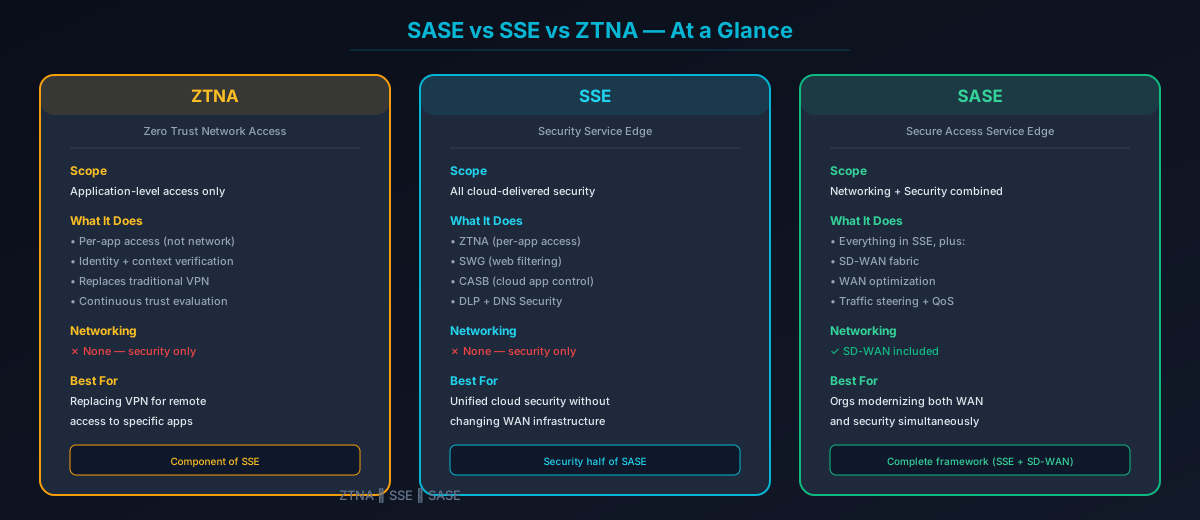
The relationship between these three concepts is hierarchical, not competitive:
- ZTNA is a capability — it handles per-application access based on identity and context.
- SSE is a platform — it bundles ZTNA together with SWG, CASB, DLP, and other security services into a unified cloud-delivered offering.
- SASE is a framework — it combines SSE (security) with SD-WAN (networking) into a complete architecture.
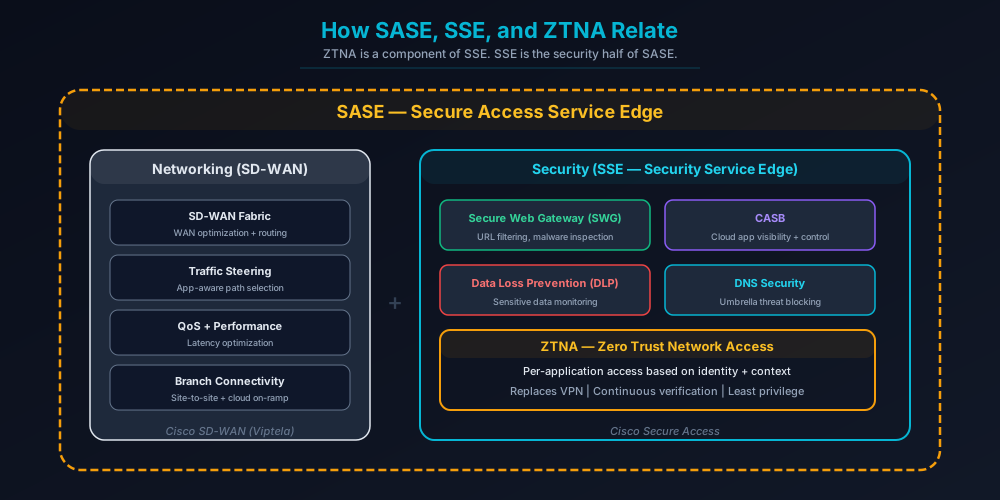
Think of it as concentric circles. ZTNA sits inside SSE, and SSE sits inside SASE. You cannot have SASE without SSE, and you cannot have SSE without ZTNA. But you absolutely can deploy ZTNA or SSE independently without committing to full SASE.
This nested structure is important because it defines a natural migration path. Most organizations do not leap to full SASE on day one. Instead, they start with ZTNA to replace VPN, expand to full SSE for broader web and cloud security, and eventually integrate SD-WAN to achieve SASE — if and when that convergence makes sense for their environment.
Which One Do You Need?
The right choice depends on where your organization sits today and where it needs to go. Here is a practical decision framework:
Start with ZTNA if:
- You need to replace or supplement aging VPN infrastructure
- Remote and hybrid workforce access is your most pressing security gap
- You want a quick win that demonstrates zero trust value to leadership
- Your existing web gateway and CASB solutions are still functional and under contract
Move to SSE if:
- You are consolidating multiple point security products (SWG, CASB, DLP) and want unified policy management
- Your organization is heavily cloud-first and needs consistent security across SaaS, web, and private applications
- You want a platform approach that reduces vendor sprawl and operational overhead
- You need integrated XDR telemetry from your security stack for better detection and response
Commit to full SASE if:
- You are also rearchitecting your WAN — replacing MPLS, deploying or refreshing SD-WAN
- You want a single vendor or deeply integrated solution for both networking and security
- Your branch office strategy is shifting toward direct internet access with local breakout
- You have the organizational alignment to bring networking and security teams under a shared operational model
Most mid-market organizations today are best served by starting with SSE. It addresses the most critical security gaps — securing web traffic, controlling SaaS usage, and providing zero trust application access — without requiring a simultaneous networking transformation.
Cisco’s Approach: Secure Access and Beyond
Cisco Secure Access is Cisco’s cloud-delivered SSE platform. It brings together the core security services under a single console and a single agent:
- ZTNA for clientless and client-based access to private applications, replacing traditional VPN with per-application, identity-aware connections
- SWG with full SSL/TLS decryption, URL filtering, and advanced threat protection for web-bound traffic
- CASB for both inline and API-based SaaS visibility and control, covering shadow IT discovery and sanctioned app governance
- DLP policies that span web, cloud, and private app channels with unified classification and response actions
- DNS-layer security powered by Cisco Umbrella’s global recursive DNS infrastructure, blocking threats before a connection is ever established
For organizations that need full SASE, Cisco Secure Access integrates with Cisco SD-WAN (formerly Viptela) and Cisco Meraki SD-WAN to deliver the networking side of the equation. This gives customers the flexibility to adopt SSE first and layer in SD-WAN integration when their network transformation timeline aligns.
A key advantage of the Cisco approach is the breadth of the security ecosystem behind it. Cisco Secure Access feeds telemetry into Cisco XDR, which correlates signals across endpoints (Cisco Secure Endpoint), email (Cisco Secure Email), network (Cisco Secure Firewall), and identity (Duo). This cross-domain visibility turns SSE from a standalone security tool into a connected sensor within a broader detection and response architecture.
Implementation Considerations
Rolling out SSE or SASE is not a weekend project. A phased approach reduces risk and builds organizational confidence:
Phase 1 — DNS Security and Basic Web Filtering (Weeks 1-4) Start with DNS-layer protection. It deploys quickly, requires minimal client-side changes, and immediately reduces exposure to known malicious infrastructure. This phase builds trust in the platform with minimal disruption.
Phase 2 — ZTNA for Priority Applications (Months 2-3) Identify your highest-risk remote access use cases — contractor access, privileged admin tools, sensitive internal applications — and migrate them from VPN to ZTNA. Measure the reduction in attack surface and the improvement in user experience.
Phase 3 — Full SWG and CASB Deployment (Months 3-6) Redirect web traffic through the SSE platform’s secure web gateway and enable CASB policies for your top SaaS applications. This is where SSL/TLS decryption policy, bypass lists, and acceptable use rules require careful planning and stakeholder communication.
Phase 4 — DLP and Advanced Controls (Months 6-9) With traffic flowing through the platform, enable DLP scanning. Start in monitor-only mode to baseline data flows and reduce false positives before switching to enforcement. Layer in remote browser isolation for high-risk categories.
Phase 5 — SD-WAN Integration for SASE (When Ready) If and when your networking team is ready, integrate SD-WAN with the SSE platform to achieve full SASE. This step requires cross-functional collaboration between network operations and security teams.
Key Takeaways
- SASE is the full picture — networking (SD-WAN) plus security (SSE) delivered from the cloud. It is the destination, not necessarily the starting point.
- SSE is the practical entry point for most organizations — it modernizes security without requiring a simultaneous network overhaul.
- ZTNA is a capability, not a platform — it replaces VPN with per-application, identity-aware access and is a component within SSE.
- The three concepts are nested, not competing — ZTNA sits inside SSE, which sits inside SASE. Your migration path follows this same progression.
- Start where the pain is greatest — for most organizations, that means ZTNA to replace VPN, then expand to full SSE for web and cloud security.
- Cisco Secure Access delivers SSE today with a clear path to full SASE through SD-WAN integration, backed by cross-domain XDR telemetry across the Cisco security portfolio.
Understanding these distinctions is not just an academic exercise. The framework you choose shapes your vendor strategy, your deployment timeline, your operational model, and ultimately how effectively you protect users and data in a cloud-first world. Get the architecture right, and the implementation decisions that follow become significantly clearer.
Related Posts
Zero Trust Network Access: Cisco Secure Access Explained
How Cisco Secure Access implements zero trust network access with SSE, ZTNA, secure web gateway, and CASB for modern hybrid workforces.
Zero Trust Architecture: Cisco Secure Access Simplification
How Cisco Secure Access simplifies zero trust architecture with unified policy management, hybrid cloud connectivity, and SSL/TLS decryption at scale.
Endpoint Detection and Response: Zero Trust Security With Cisco
How Cisco Secure Endpoint combines EDR, endpoint protection, vulnerability management, and DLP to deliver zero trust security for modern enterprises.