Zero Trust Security: The Complete Guide
What Is Zero Trust?
Zero Trust is a security framework built on a simple principle: never trust, always verify. Unlike traditional perimeter-based security that assumes everything inside the corporate network is safe, Zero Trust treats every user, device, and connection as potentially compromised until proven otherwise.
Zero Trust is not a single product — it’s an architectural philosophy that requires continuous verification across your entire infrastructure. Every access request is evaluated based on identity, device posture, location, and context before access is granted — and that verification continues throughout the session.
Traditional Perimeter vs. Zero Trust
The traditional “castle and moat” security model assumed that threats came from outside the network. Once a user was inside — authenticated through a VPN or sitting in the office — they were implicitly trusted with broad access to internal resources. This model worked when users, devices, and applications were all inside the corporate network.
That model is fundamentally broken in 2026. Remote work, cloud applications, SaaS adoption, and mobile devices mean that the network perimeter no longer defines the security boundary. Attackers who breach the perimeter through phishing, credential theft, or supply chain attacks have free rein to move laterally across flat networks.
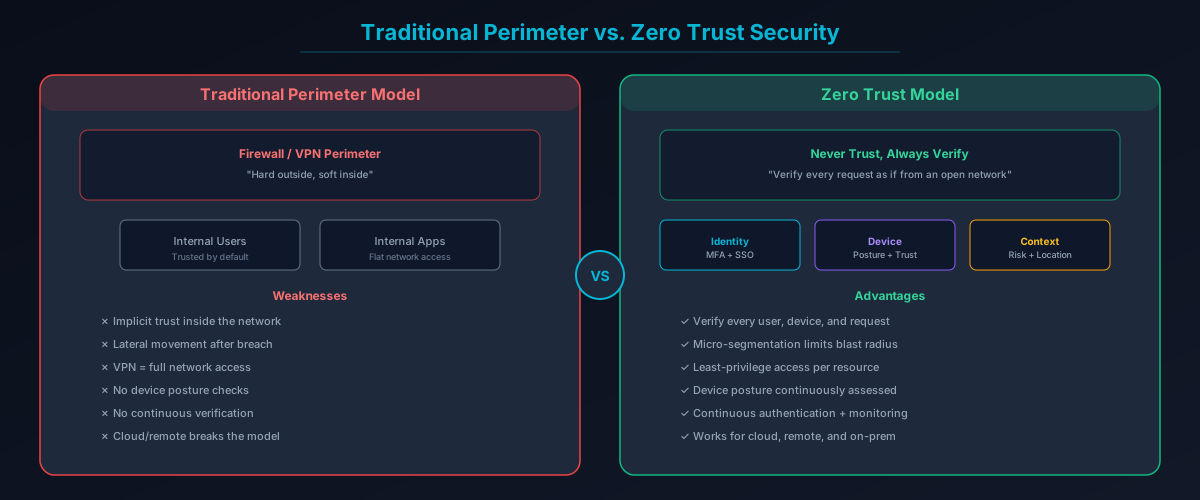
Zero Trust eliminates implicit trust entirely. Every request — regardless of where it originates — is verified, authorized, and encrypted before access is granted. Users get access to specific applications rather than entire network segments, and that access is continuously reassessed.
Zero Trust Architecture
A complete Zero Trust architecture places a Policy Decision Point at the center of every access request. Users and devices — whether remote workers, corporate endpoints, IoT devices, or third-party contractors — must pass through identity verification, device trust assessment, and contextual risk scoring before reaching any resource.
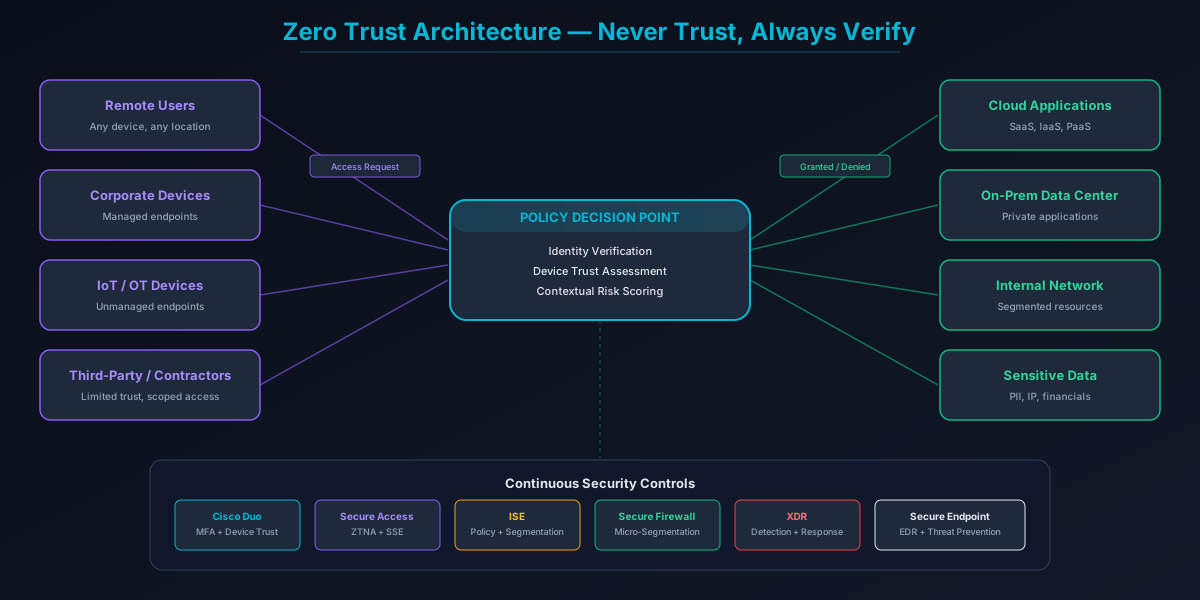
The architecture is supported by a continuous security layer that includes Cisco Duo for MFA, Cisco Secure Access for ZTNA, Cisco ISE for policy and segmentation, Cisco Secure Firewall for micro-segmentation, Cisco XDR for detection and response, and Cisco Secure Endpoint for threat prevention.
The Five Pillars of Zero Trust
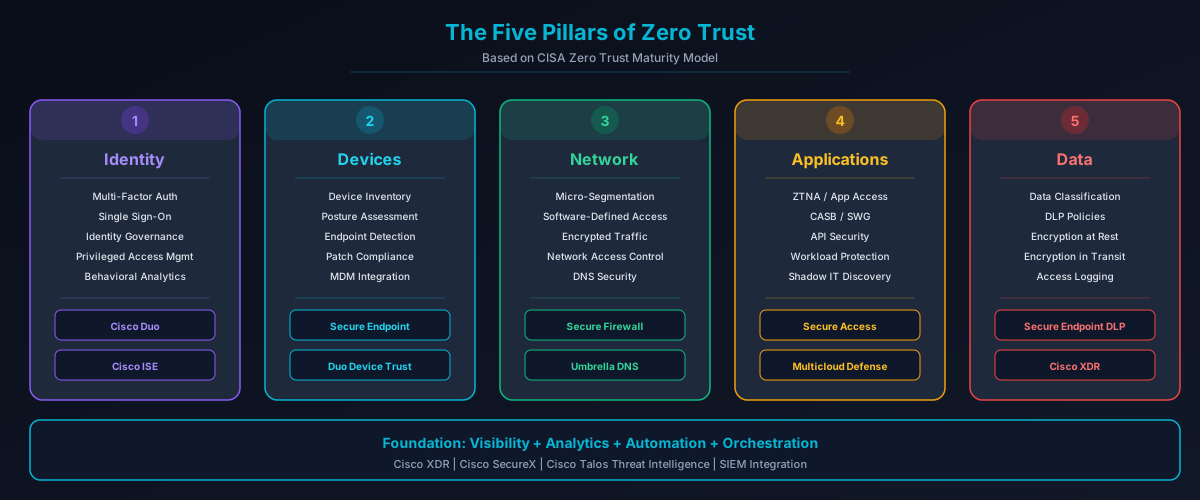
The CISA Zero Trust Maturity Model defines five pillars that organizations must address to achieve a comprehensive Zero Trust posture. Each pillar maps directly to Cisco security products that enable implementation.
Pillar 1: Identity
Identity is the foundation of Zero Trust. Every access decision starts with verifying who the user is and whether their credentials are legitimate. This goes beyond simple username and password — it requires multi-factor authentication, single sign-on, identity governance, privileged access management, and behavioral analytics.
Cisco Duo provides adaptive MFA that evaluates risk based on user behavior, location, device posture, and network context. It supports phishing-resistant authentication methods including Verified Push (requiring code entry to prevent push fatigue attacks), FIDO2 WebAuthn hardware keys, and passwordless biometric login.
Cisco ISE (Identity Services Engine) enforces network access policies based on identity context. It integrates with Active Directory, LDAP, and SAML providers to make identity-aware access decisions at the network layer.
Pillar 2: Devices
Every device that connects to your environment is a potential attack surface. Zero Trust requires continuous assessment of device health — is it running a supported OS? Is disk encryption enabled? Is the endpoint protection agent installed and current? Is the device managed or personal?
Cisco Secure Endpoint provides endpoint detection and response (EDR) capabilities that continuously monitor device health, detect threats, and enable automated remediation. It shares telemetry with Cisco XDR for cross-domain correlation.
Cisco Duo Device Trust evaluates device posture at every authentication event. It can block access from devices that don’t meet security baselines — for example, requiring FileVault encryption on macOS or up-to-date Windows patches before granting access to sensitive applications.
Pillar 3: Network
The network pillar focuses on micro-segmentation — dividing your network into small, isolated zones to prevent lateral movement. Even if an attacker compromises a user account or device, segmentation limits the blast radius to a single zone rather than the entire network.
Cisco Secure Firewall enforces micro-segmentation policies between network segments, inspecting traffic between zones with IPS, malware detection, and encrypted traffic analytics.
Cisco Umbrella provides DNS-layer security that blocks connections to malicious domains before they reach the network. It acts as the first line of defense against phishing, malware, and command-and-control callbacks.
Pillar 4: Applications
Applications — whether SaaS, private, or web-based — need Zero Trust access controls that go beyond network-level protection. Zero Trust Network Access (ZTNA) replaces traditional VPNs with per-application access based on identity and context.
Cisco Secure Access delivers a complete Security Service Edge (SSE) platform that combines ZTNA, Secure Web Gateway (SWG), Cloud Access Security Broker (CASB), and Data Loss Prevention (DLP) in a unified solution.
Cisco Multicloud Defense extends application security to cloud workloads across AWS, Azure, and GCP, providing consistent policy enforcement regardless of where applications run.
Pillar 5: Data
Data is ultimately what Zero Trust protects. The data pillar ensures that sensitive information is classified, encrypted, and monitored — whether at rest, in transit, or in use.
Cisco Secure Endpoint DLP prevents unauthorized data exfiltration from endpoints, monitoring clipboard activity, file transfers, and removable media.
Cisco XDR provides cross-domain visibility into data access patterns, correlating signals from identity, endpoint, network, and cloud to detect data exfiltration attempts.
Cisco Duo — Adaptive Multi-Factor Authentication
Cisco Duo is the identity verification backbone of Cisco’s Zero Trust architecture. It goes far beyond basic MFA to provide adaptive, risk-based authentication that evaluates multiple factors before granting access.
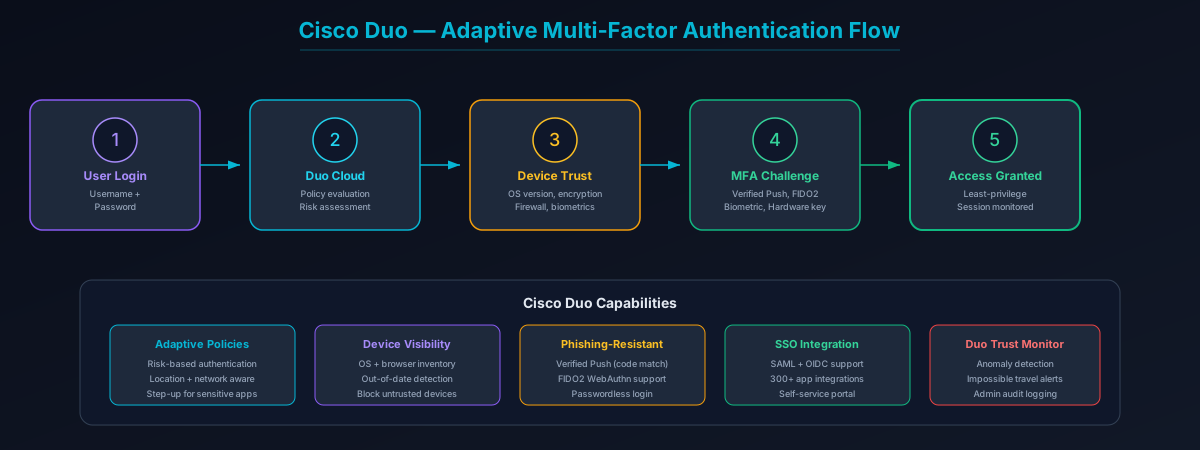
The Duo authentication flow evaluates five stages:
- User Login — The user provides primary credentials (username + password or passwordless)
- Duo Cloud — Duo’s cloud service evaluates policies and assesses risk based on the request context
- Device Trust — The device is checked for OS version, encryption status, firewall state, and biometric availability
- MFA Challenge — A phishing-resistant second factor is requested: Verified Push, FIDO2 hardware key, or biometric
- Access Granted — If all checks pass, the user receives least-privilege access and the session is continuously monitored
Duo’s Trust Monitor uses machine learning to detect anomalous authentication patterns — impossible travel, unusual login times, and suspicious device changes — alerting security teams to potential credential compromise.
Cisco Secure Access — SSE and ZTNA
Cisco Secure Access is the platform that delivers Zero Trust Network Access at scale. As a Security Service Edge (SSE) solution, it consolidates multiple security functions into a single cloud-delivered platform.
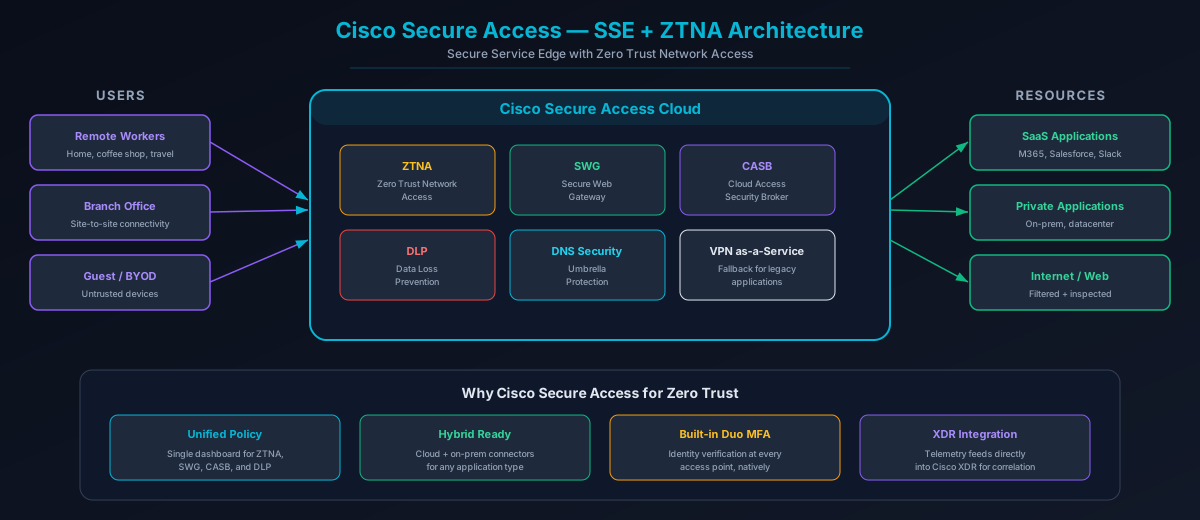
Secure Access combines six core capabilities:
- ZTNA — Per-application access based on identity and context, replacing broad VPN access with granular controls
- SWG — Secure Web Gateway that inspects and filters all web traffic, blocking malicious content and enforcing acceptable use policies
- CASB — Cloud Access Security Broker that provides visibility and control over SaaS application usage, detecting shadow IT and enforcing data policies
- DLP — Data Loss Prevention that monitors and blocks sensitive data from leaving the organization through web, cloud, or email channels
- DNS Security — Umbrella-powered DNS filtering that blocks malicious domains at the earliest point in the attack chain
- VPN as-a-Service — Fallback connectivity for legacy applications that cannot yet support ZTNA
The platform manages all of these through a unified policy dashboard, eliminating the complexity of managing separate point products with separate consoles.
Real-World Zero Trust Implementations
Google BeyondCorp
Google pioneered the Zero Trust approach with BeyondCorp, eliminating the concept of a privileged internal network entirely. Every access request — whether from a coffee shop or Google’s corporate office — goes through the same identity verification and device trust assessment. The result: no VPN required, consistent security posture regardless of location, and a model that has scaled to hundreds of thousands of employees.
Cisco’s Own Journey
Cisco IT implemented Zero Trust across their globally distributed workforce, achieving 92% login suppression through SSO and passwordless authentication while maintaining strong security posture. Their approach prioritized user experience alongside security — proving that Zero Trust doesn’t have to mean more friction for users.
Implementation Roadmap
Getting started with Zero Trust requires a phased approach. Trying to implement everything at once leads to failed projects and security gaps.
- Assess your current state — map your data flows, identify sensitive assets, catalog all users and devices, understand who needs access to what
- Start with identity — deploy Cisco Duo and implement MFA everywhere, beginning with privileged accounts and sensitive applications
- Establish device trust — use Duo Device Trust and Secure Endpoint to assess device posture and block non-compliant devices
- Deploy ZTNA — implement Cisco Secure Access to replace VPN with per-application access for cloud and private applications
- Segment your network — use Cisco ISE and Secure Firewall to implement micro-segmentation and limit lateral movement
- Monitor everything — deploy Cisco XDR for cross-domain visibility, correlation, and automated response
- Iterate and mature — continuously assess your Zero Trust maturity against the CISA model and expand coverage
Frequently Asked Questions
What is Zero Trust security? Zero Trust is a security framework built on the principle of “never trust, always verify.” Unlike traditional perimeter-based security, Zero Trust treats every user, device, and connection as potentially compromised until verified through continuous authentication and authorization.
What are the five pillars of Zero Trust? The five pillars, based on the CISA Zero Trust Maturity Model, are: Identity (MFA, SSO, governance), Devices (posture, EDR, compliance), Network (micro-segmentation, DNS security), Applications (ZTNA, CASB, SWG), and Data (DLP, encryption, classification). All five are supported by visibility, analytics, and automation.
How does Cisco implement Zero Trust? Cisco implements Zero Trust through multiple integrated products: Cisco Duo for identity verification and MFA, Cisco ISE for network segmentation and policy, Cisco Secure Firewall for micro-segmentation, Cisco Secure Access for ZTNA and SSE, Cisco Secure Endpoint for EDR, and Cisco XDR for continuous monitoring and threat correlation.
What is the difference between Zero Trust and VPN? Traditional VPNs grant broad network access once a user authenticates, while Zero Trust Network Access (ZTNA) provides per-application access based on identity and context. ZTNA continuously verifies trust rather than granting blanket access after a single login. Cisco Secure Access provides ZTNA as part of its SSE platform.
How do I get started with Zero Trust? Start by assessing your current state and mapping data flows. Then implement MFA everywhere beginning with privileged accounts using Cisco Duo, segment your network with Cisco ISE and Secure Firewall, deploy Cisco Secure Access for ZTNA, add Secure Endpoint for EDR, and implement Cisco XDR for cross-domain visibility.
Related Guides
Looking to deepen your security knowledge? Explore our other comprehensive guides:
- XDR Explained: Extended Detection and Response Guide — Learn how XDR correlates threats across endpoints, network, and cloud for unified detection and response. Zero Trust and XDR work together to provide continuous monitoring and automated threat response.
- Cisco Firewall Guide: From ASA to FTD — Understand Cisco’s firewall evolution and how Firepower Threat Defense enforces Zero Trust policies at the network perimeter with advanced threat detection.
Related Episodes
Episodes & Posts on This Topic
SASE vs SSE vs ZTNA: Understanding the Key Differences
Compare SASE, SSE, and ZTNA architectures side by side. Learn which framework fits your organization and how Cisco Secure Access delivers all three.
Cisco ISE Configuration Guide: 802.1X, Profiling, and Secure Access
Step-by-step Cisco ISE setup guide covering 802.1X for wired, wireless, and VPN. Includes switch configs, Windows supplicant setup, FTD/FMC RADIUS, and …
Identity is the New Perimeter — How Attackers Bypass MFA in 2026
Identity has replaced email as the top threat vector. Learn how attackers bypass MFA with push fatigue, token theft, and OAuth abuse, plus defense strategies.


Zero Trust Architecture: Real-World Examples & Implementation
Practical Zero Trust architecture examples and implementation strategies including micro-segmentation, identity verification, and Google BeyondCorp.
Network Segmentation Strategy: Micro vs VLAN Approaches
VLAN vs micro-segmentation: compare network segmentation strategies including Security Group Tags, group-based policy, and zero trust enforcement.
Zero Trust Architecture: Cisco Secure Access Simplification
How Cisco Secure Access simplifies zero trust architecture with unified policy management, hybrid cloud connectivity, and SSL/TLS decryption at scale.
Zero Trust Security: Beyond Products to Concepts
Why zero trust security is a philosophy, not a product. Learn the foundational concepts, MFA requirements, and practical implementation strategies.
Zero Trust Security Strategy: Expert Insights on Implementation
Expert insights on implementing zero trust security strategy with MFA, endpoint protection, network segmentation, and a multi-vendor approach.
Zero Trust Network Access: Cisco Secure Access Explained
How Cisco Secure Access implements zero trust network access with SSE, ZTNA, secure web gateway, and CASB for modern hybrid workforces.
Zero Trust Identity Management with Cisco ISE
Learn how Cisco ISE enforces zero trust identity management through centralized access control, device profiling, MFA integration, and micro-segmentation.
Endpoint Detection and Response: Zero Trust Security With Cisco
How Cisco Secure Endpoint combines EDR, endpoint protection, vulnerability management, and DLP to deliver zero trust security for modern enterprises.